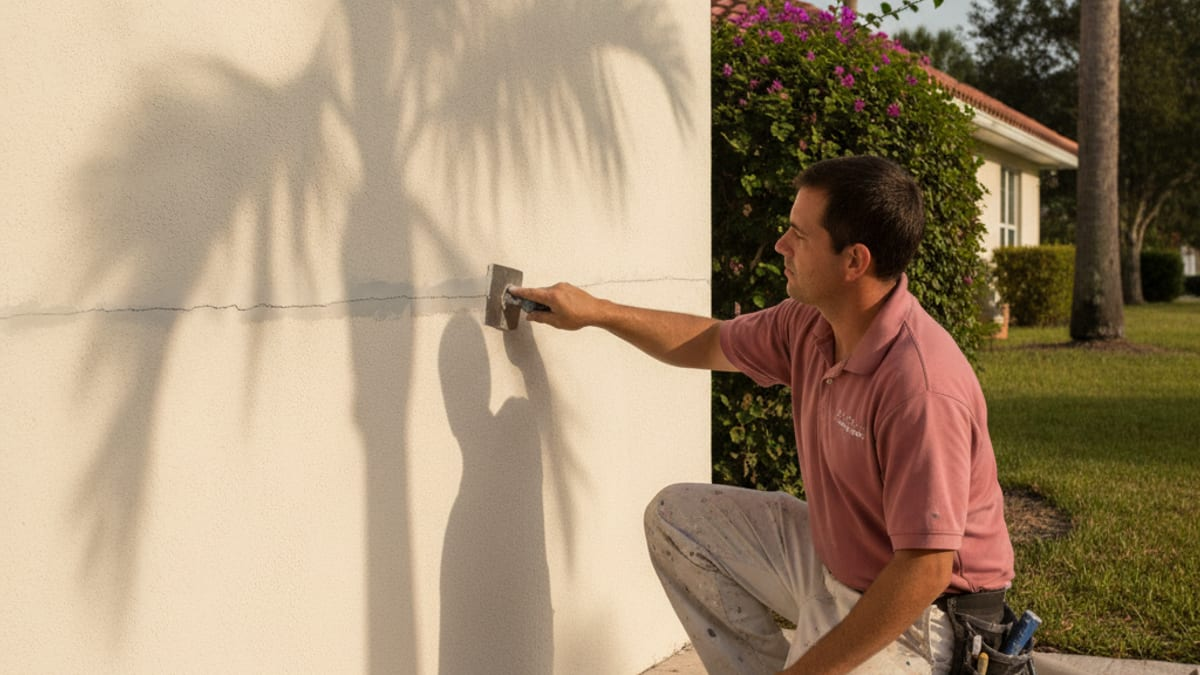
Almost every stucco home in Tampa Bay develops some hairline cracking over time, and painting over those cracks without repairing them first is one of the most common reasons an exterior paint job fails early. Here’s why the cracks happen, which ones actually matter, and why the repair order has to come before the paint, not after.
Why stucco cracks in the first place
Stucco is a rigid material applied over concrete block or a wire lath system, and it doesn’t flex the way siding or drywall can. Florida’s clay-heavy and sandy soils shift seasonally with rainfall and drought cycles, and that slab movement transfers stress into the stucco above it, producing the thin, often diagonal hairline cracks that show up around windows, doors, and corners first.
Hurricane season adds another layer. Repeated wind load on a home’s exterior over years of storm seasons flexes the structure slightly each time, and stucco, being rigid, eventually shows that stress as cracking rather than absorbing it invisibly. Temperature swings between a scorching afternoon and a cooler evening also cause expansion and contraction that, over enough cycles, opens hairline cracks in aging stucco.
Why painting over a crack makes it worse
Paint is not a structural material, and a standard exterior coat can’t bridge or seal a crack on its own. When paint goes over an unrepaired crack, water still finds its way in through capillary action during Florida’s frequent summer storms. That trapped moisture behind the paint film has nowhere to evaporate quickly in high humidity, and the paint bubbles, peels, or fails right at the crack line, often within a single season.
Worse, water that gets behind stucco through an unrepaired crack can reach the wood framing, insulation, or metal lath underneath, leading to rot or corrosion that’s far more expensive to fix than the original crack ever would have been. What starts as a $200 repair problem can turn into a multi-thousand-dollar wall reconstruction if it’s ignored long enough.
Cosmetic cracks versus structural cracks
Most stucco cracks are cosmetic: thin, hairline, and limited to the surface stucco layer without any sign of movement in the wall behind it. These are typically repaired by cleaning out the crack, applying a flexible acrylic caulk or stucco patch compound rated for exterior use, and re-texturing to match the surrounding wall before painting.
A different category of crack is worth taking seriously. Cracks wider than about an eighth of an inch, cracks that run in a stair-step pattern through the block joints, or cracks accompanied by visible bulging or displacement of the wall surface can signal actual structural movement rather than surface shrinkage. This work crosses into territory that may fall under a CBC or CRC-licensed contractor’s scope in Florida, and it’s worth verifying license status at myfloridalicense.com before anyone touches that kind of repair, separate from the standard painting and cosmetic patching crew.
The right repair order
For a standard hairline crack repair, the sequence matters. The crack gets cleaned of loose material and dust first, then filled with a compound designed to move slightly with the stucco rather than a rigid filler that just cracks again in the same spot. Once that cures, the patch gets textured to match the surrounding stucco’s finish, whether that’s a smooth, sand, or heavier dash texture, since a mismatched patch texture shows through paint even after the color goes on.
Only after the patch has fully cured, typically several days depending on humidity and temperature, does priming and painting begin. Painting too soon over a fresh patch traps moisture from the repair compound itself and can cause the same bubbling and peeling problem the repair was meant to prevent.
Elastomeric coatings and crack-prone stucco
For stucco with a history of repeated hairline cracking, an elastomeric coating is worth considering instead of standard exterior paint. Elastomeric coatings apply thicker than regular paint and stay flexible after curing, which lets them bridge small hairline movement without cracking the same way rigid paint does. It costs more upfront than a standard exterior paint job, but on stucco that’s already shown a pattern of surface cracking, it can meaningfully reduce how often repair and repaint cycles come around.
Real cost by crack severity
Minor hairline cracks, typically the width of a credit card or thinner and limited to a few isolated spots around windows or corners, usually run $200-$600 to patch and re-texture properly as part of a standard exterior repaint prep. A home with more extensive hairline cracking across multiple walls, common in stucco homes past the 20 to 25-year mark, can push repair costs to $800-$1,800 once every affected area gets addressed.
Cracks that suggest deeper movement, particularly stair-step patterns through block joints or cracking near foundation corners, require a more thorough evaluation, and repair costs at that point depend entirely on what’s actually happening structurally rather than a standard per-crack estimate. This is where getting an honest opinion from a licensed contractor before assuming it’s a simple cosmetic fix matters most.
Spotting early warning signs between repaint cycles
Homeowners don’t need to wait for a full repaint to keep an eye on stucco condition. A quick walk around the exterior once or twice a year, particularly after a rough hurricane season, catches new hairline cracking early before it has years to widen or let water intrusion cause hidden damage behind the wall. Areas around window and door corners, where stress concentrates most, are worth checking first.
Discoloration or a slightly darker, damp-looking patch of stucco that doesn’t dry out even on a sunny day can indicate water intrusion behind the surface, sometimes from a crack that isn’t very visible from a distance. This is worth having looked at promptly rather than waiting for the next scheduled repaint, since ongoing moisture behind stucco causes more expensive damage the longer it goes unaddressed.
Insurance considerations for stucco damage
Standard homeowners insurance in Florida typically covers stucco damage from a specific, sudden event, wind-driven debris during a storm, for example, but doesn’t cover gradual cracking from normal aging, settling, or humidity cycling, which insurers generally classify as a maintenance issue rather than storm damage. If a crack appeared suddenly after a specific storm event, documenting it with photos and a repair estimate promptly is worth doing in case a claim is warranted, but routine hairline cracking from normal home aging is properly treated as ongoing maintenance, not an insurance matter.
What homeowners should ask before hiring for stucco repair
A straightforward question worth asking any contractor: are they repairing the crack with a flexible, exterior-rated compound, or a generic filler that isn’t built to move with the wall? Rigid fillers on a home that’s clearly experiencing seasonal movement tend to fail again at the same spot within a year or two, which means paying for the same repair twice.
It’s also worth asking how long the patch needs to cure before painting, and confirming the crew isn’t planning to paint the same day repairs are made. Florida humidity extends cure times beyond what a product label states for drier climates, and rushing this step undoes the point of doing the repair in the first place.
Why can’t I just paint over a stucco crack?
Paint isn’t structural and can’t seal a crack against water intrusion. Painting over an unrepaired crack traps moisture that causes early paint failure and, over time, can lead to rot or corrosion in the framing behind the stucco.
How do I know if a stucco crack is serious?
Thin hairline cracks are usually cosmetic. Cracks wider than about an eighth of an inch, stair-step patterns through block joints, or any visible bulging in the wall surface are worth having evaluated, since they may signal structural movement rather than surface shrinkage.
Should I get an elastomeric coating instead of standard paint?
If your stucco has a history of repeated hairline cracking, an elastomeric coating’s flexibility can reduce how often cracks reopen compared to standard rigid paint, though it costs more upfront.
How long does stucco crack repair need to cure before painting?
It varies with humidity and temperature, but generally several days at minimum. Painting too soon over a fresh patch traps moisture from the repair compound and can cause the same failure the repair was meant to prevent.
If you’re seeing cracking on your stucco exterior, call (813) 000-0000 and we’ll connect you with a local crew that repairs it right before any paint goes on.