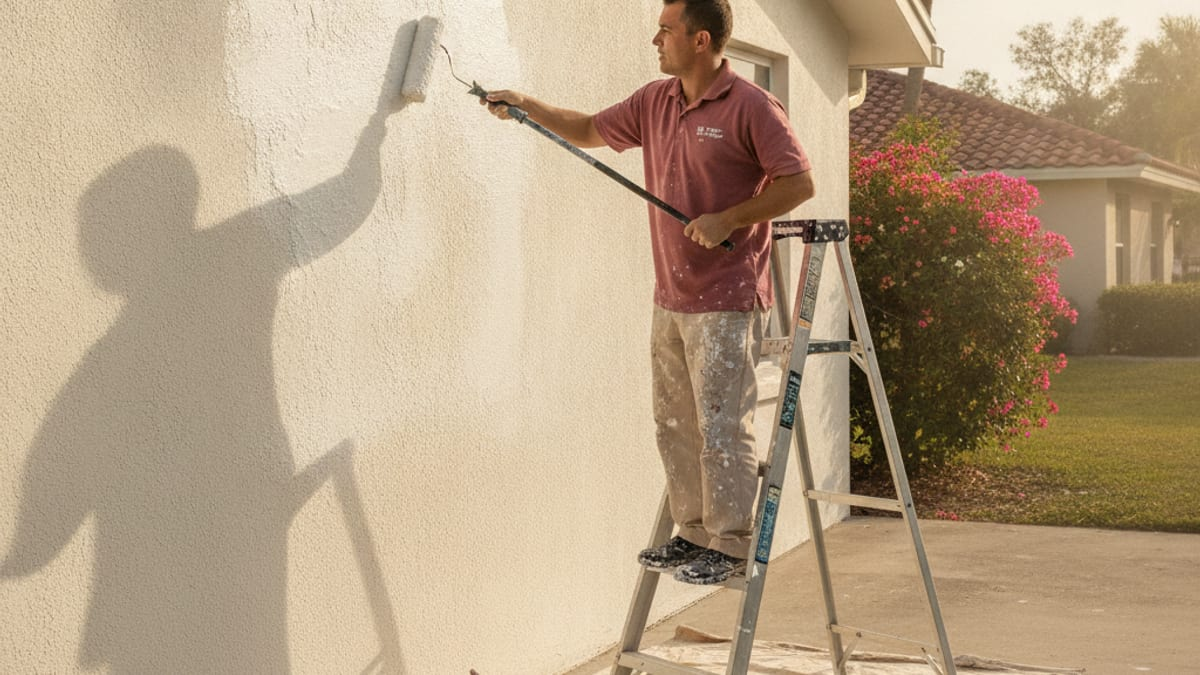
Elastomeric coating comes up in almost every conversation about repainting an older Tampa Bay stucco home, usually because a homeowner has already dealt with hairline cracking or a paint job that failed faster than expected. It costs more than standard exterior paint, and it’s not the right call for every home, so here’s what it actually does and how to decide if it’s worth the upcharge.
What makes elastomeric coating different from standard paint
Standard exterior paint is formulated to be thin and rigid once it cures, which works fine on a stable surface but offers almost no ability to move with the substrate underneath. Elastomeric coating is formulated differently, applying much thicker, often several times the mil thickness of regular paint, and staying flexible after it cures rather than hardening rigid.
That flexibility is the whole point. On stucco, which develops hairline cracking from soil movement, temperature cycling, and hurricane-season wind load, an elastomeric coating can stretch and bridge small movement in the surface underneath without cracking itself. Standard paint over the same hairline movement eventually cracks right along with the stucco.
Where elastomeric coatings genuinely help
Stucco homes with a documented history of recurring hairline cracking, particularly around windows, doors, and corners where stress concentrates, are the clearest case for elastomeric coating. If you’ve repainted a home twice in ten years and the same cracks keep reappearing at the same spots each time, that’s a pattern elastomeric coating is specifically built to address, since it moves with the stucco instead of fighting it.
It also performs well as a genuine waterproofing layer, not just a paint color. Because of its thickness and flexibility, a properly applied elastomeric coating provides meaningfully better resistance to wind-driven rain intrusion through stucco than standard paint, which matters during Tampa Bay’s summer storm season when horizontal rain against a west or south-facing wall is a regular occurrence.
Where it’s not necessary
A stucco home in good structural condition with minimal or no cracking history doesn’t need elastomeric coating to hold up well. Standard exterior paint, properly prepped and applied with attention to Florida’s humidity and UV exposure, performs perfectly well on stable stucco. Elastomeric coating on a crack-free wall is paying for flexibility you don’t currently need, though some homeowners choose it preventively if they’re planning to own the home long term and want to head off future cracking before it starts.
It’s also worth knowing that elastomeric coating is harder to remove or repaint over with standard paint later, since its thickness and texture differ meaningfully from regular paint film. That’s a long-term commitment worth understanding before applying it, not a decision to make purely on this repaint cycle’s cost.
Cost difference versus standard exterior paint
Elastomeric coating typically costs 30-50% more than standard exterior paint per square foot, driven by both material cost and the additional labor of applying multiple thicker coats correctly. On a typical 1,500-square-foot single-story stucco home, that might mean a $6,000-$9,500 project instead of a $4,500-$8,500 standard exterior repaint.
The trade-off is repaint frequency. A well-applied elastomeric coating on crack-prone stucco can extend the interval between full repaints, since it’s not failing at crack lines the way standard paint does, which partially offsets the higher upfront cost over the life of the coating.
Preparation matters even more with elastomeric coating
Because elastomeric coating is thicker and more expensive than standard paint, cutting corners on prep costs more when it goes wrong. Stucco crack repair for any existing damage still needs to happen before the coating goes on, since elastomeric coating bridges future minor movement, it doesn’t fix or fill existing structural damage. A thorough pressure wash to remove mildew, dirt, and chalking residue matters just as much here as with standard paint, since elastomeric coating needs a clean, stable surface to bond properly.
Real cost example by home size
For a 1,500-square-foot single-story stucco home with roughly 1,800-2,200 square feet of exterior wall surface, elastomeric coating typically runs $6,000-$9,500 including prep, crack repair, and the multiple coats needed to reach proper thickness. A larger two-story home, 2,800 square feet and up, often runs $12,000-$18,500 given the additional wall surface and the lift equipment two-story exteriors typically require.
For comparison, that same two-story home would likely run $9,000-$16,000 with standard exterior paint, so the elastomeric upcharge on a larger home can mean a real difference of several thousand dollars, which is worth weighing seriously against how much cracking history the home actually has before committing.
Color and texture options with elastomeric coating
Elastomeric coatings come in a full range of colors, similar to standard exterior paint, so choosing this coating type doesn’t limit your color options. Texture is a slightly different story. Because the coating applies thicker than standard paint, it can slightly soften or round off very fine stucco texture detail, which is rarely noticeable on standard sand or medium textures but is worth discussing with your contractor if your home has a distinctive, fine decorative texture you want preserved exactly as is.
Maintenance over the life of the coating
A well-applied elastomeric coating generally holds up longer between full repaints than standard exterior paint on crack-prone stucco, often extending the interval by several years, though it still benefits from periodic pressure washing to remove mildew and dirt buildup between full repaint cycles, the same as any exterior finish would in Tampa Bay’s humidity.
Touch-ups on elastomeric coating are more involved than touching up standard paint, since matching the thickness and texture of an existing elastomeric application with a small touch-up requires more care than a quick brush of standard paint over a scuff. Keeping a small amount of the original product on hand, properly stored, makes future minor touch-ups more consistent if the need comes up.
What to ask before choosing elastomeric coating
Ask directly whether the crew has experience applying elastomeric coatings specifically, since the application technique and coat thickness differ from standard exterior paint and getting it wrong reduces the flexibility benefit that makes the product worth the extra cost in the first place. It’s also worth asking how many coats are included in the quote, since elastomeric coating typically needs a specific number of passes to reach its rated thickness, and a quote that skips coats to save time undercuts the whole reason to choose it over standard paint.
Getting a second opinion before committing
Because elastomeric coating represents a meaningful cost increase over standard exterior paint, it’s reasonable to get more than one contractor’s assessment of whether your specific stucco condition genuinely warrants it. A crew that recommends elastomeric coating on every job regardless of crack history is worth questioning, since the product’s real value is specifically tied to addressing recurring movement, not a universal upgrade every stucco home needs. An honest contractor should be able to point to the specific evidence on your walls, active or repeated cracking at particular locations, that supports the recommendation.
What is elastomeric coating and how is it different from regular paint?
Elastomeric coating applies much thicker than standard exterior paint and stays flexible after curing, allowing it to bridge small hairline cracks in stucco without cracking itself, unlike standard rigid paint film.
Is elastomeric coating worth the extra cost?
For stucco with a history of recurring hairline cracking, yes, since it addresses the actual movement causing repeated paint failure. For crack-free, structurally sound stucco, standard exterior paint performs well without the upcharge.
Can elastomeric coating be applied over an existing standard paint job?
Generally yes, as long as the existing paint is well-adhered and the surface is properly cleaned and prepped first. A contractor should still check for any loose or failing paint underneath, since elastomeric coating applied over an unstable existing layer will eventually fail along with whatever it was applied on top of.
How much more does elastomeric coating cost than standard paint?
Typically 30-50% more per square foot, driven by material cost and the labor of applying multiple thicker coats correctly.
Do I still need crack repair if I’m using elastomeric coating?
Yes. Elastomeric coating bridges future minor movement, but it doesn’t fix existing structural damage or cracks. Repair still needs to happen before the coating goes on.
If your stucco keeps cracking in the same spots after every repaint, call (813) 000-0000 and we’ll connect you with a local crew experienced in elastomeric coating, from homes near the salt air of Clearwater Beach to inland stucco in Land O’ Lakes.