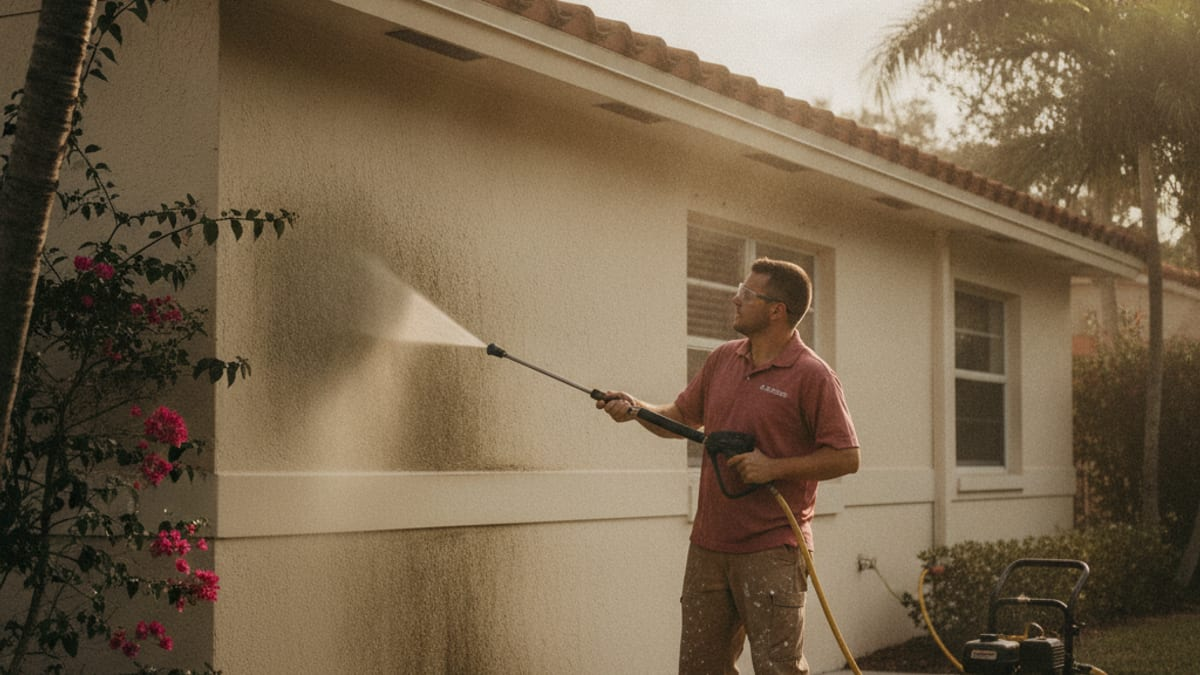
Skipping pressure washing before an exterior repaint is one of the fastest ways to end up with a paint job that fails within a year or two in Tampa Bay. Year-round humidity and frequent summer rain make mildew, algae, and dirt buildup on exterior walls close to universal here, not an occasional problem some homes have and others don’t. Here’s why this step matters as much as it does and what it actually involves.
What’s actually growing on your walls
Mildew and algae thrive in warm, humid, shaded conditions, and Tampa Bay’s climate provides exactly that for a large chunk of the year. North and east-facing walls, along with any area shaded by trees, roof overhangs, or neighboring structures, tend to show the heaviest growth since they stay damp longest after rain and get the least direct sun to dry them out.
Stucco is particularly prone to this because its textured, porous surface gives mildew spores and algae more surface area to grip onto than a smooth surface would. A wall that looks like it just has general dirt or discoloration from a distance is often, on closer inspection, actually coated in a thin layer of biological growth that ordinary rain never fully rinses away.
Why this matters for paint adhesion, not just appearance
Paint needs to bond directly to a clean, stable surface to form a proper film and hold up over time. Painting over mildew, algae, dirt, or chalking old paint residue means the new coat is bonding to that layer instead of the actual wall surface underneath, and that bond is inherently weaker and less durable.
The consequences show up fast. Paint applied over unwashed mildew often fails within a year, sometimes visibly staining right through the new paint as the mildew underneath continues growing, since paint alone doesn’t kill existing mildew, it just temporarily covers it. This is one of the most common reasons a fresh-looking paint job in Tampa Bay starts showing streaking or discoloration again within twelve to eighteen months, far sooner than a properly prepped job should.
What proper pressure washing prep involves
A proper pre-paint pressure wash isn’t just blasting water at the house. It typically involves a cleaning solution formulated to kill mildew and algae at the surface, not just rinse away visible growth, followed by a controlled pressure wash at a psi level appropriate for the surface material. Stucco, being more porous and somewhat more delicate than solid wood or fiber-cement siding, needs a different pressure setting than a harder surface to avoid etching or damaging the texture.
Pressure washing before painting also removes chalking, the powdery residue that forms as old exterior paint breaks down under UV exposure over years. Chalking residue left on a wall prevents new paint from bonding properly, similar to how mildew does, and a proper wash strips that layer away to expose a clean, paintable surface.
Drying time before painting begins
After a proper wash, the exterior needs time to dry fully before any paint goes on, and Florida’s humidity extends that window compared to drier climates. Depending on humidity levels, temperature, and how much direct sun the walls get, this typically means waiting 24-48 hours between washing and painting, sometimes longer during the wettest parts of summer. Painting over a surface that’s still damp traps moisture under the new paint film, which can cause the same bubbling and peeling problems that skipping the wash altogether would.
Combining pressure washing with crack repair
For exterior painting on stucco homes, pressure washing typically happens before crack repair and patching begins, since the wash reveals the true condition of the surface, including cracks or damage that might have been partially hidden under dirt or growth. A contractor doing the prep work in the right order, wash first, then assess and repair damage, then paint, catches issues a rushed job would miss entirely.
How often should exterior walls get pressure washed, even without painting
Beyond pre-paint prep, a lot of Tampa Bay homeowners benefit from a standalone pressure wash every one to two years just to manage mildew and algae buildup between paint cycles, particularly on the shadier sides of the house. This doesn’t replace the more thorough pre-paint wash, which uses a cleaning solution specifically to kill growth rather than just rinse the surface, but it does help slow how quickly a fresh paint job starts showing discoloration again.
DIY pressure washing risks worth knowing about
Renting a pressure washer and tackling this yourself is possible, but it carries real risk that’s worth understanding before deciding to skip a professional. Using too high a psi setting, especially on stucco or older, softer siding, can etch, gouge, or strip away surface material rather than just cleaning it, creating damage that then needs its own repair before painting can happen. Standing too close to the surface or using the wrong nozzle tip produces the same problem even at a moderate overall pressure setting.
There’s also the mildew-killing step to consider. A plain water rinse, even at high pressure, knocks visible growth off the surface but doesn’t necessarily kill the mildew spores at the root, which means growth can reappear within weeks, sometimes faster than the new paint has even fully cured. A proper cleaning solution formulated to kill mildew and algae, applied before the pressure rinse, addresses the actual organism, not just its visible surface layer.
What a professional pre-paint wash includes, step by step
A thorough professional process typically starts with an inspection of the exterior to identify heavy mildew zones, chalking areas, and any surfaces needing special attention, like a deck or delicate trim that needs a gentler approach than the main stucco walls. Next comes application of a cleaning solution, allowed to sit and work on the surface for the manufacturer-recommended time before rinsing. The pressure rinse itself uses a psi setting matched to the specific surface material, followed by a final inspection to confirm all growth, chalking, and dirt have been fully removed before calling the wash complete and ready for the drying period.
Cost of pressure washing as a standalone service versus bundled prep
As a standalone service, exterior pressure washing for a typical single-story Tampa Bay home runs $250-$500 depending on square footage and how heavy the mildew and dirt buildup is. When bundled as prep work within a full exterior painting project, it’s often priced as part of the overall project cost rather than itemized separately, though it’s reasonable to ask your contractor to break out that line item if you want to understand exactly what you’re paying for it.
Why a phone quote can’t account for this
The amount of mildew growth, chalking, and general buildup varies significantly from house to house depending on shade, exposure, tree coverage, and how long it’s been since the last wash. A contractor who quotes pressure washing sight unseen over the phone is guessing, and an accurate estimate really does require seeing the actual condition of the walls in person before committing to a price and timeline.
Roofs, walkways, and other surfaces worth washing at the same time
While a crew has equipment on site for a pre-paint exterior wash, it’s often efficient to address adjacent surfaces at the same time, walkways, driveways, and pool decks that accumulate the same mildew and algae growth as exterior walls. These surfaces use different pressure settings and sometimes different cleaning solutions than painted walls, so it’s worth confirming with your contractor whether this is included or priced as an add-on rather than assuming it’s automatically part of the exterior wash scope.
Why is pressure washing necessary before exterior painting in Tampa Bay?
Year-round humidity makes mildew and algae growth on exterior walls close to universal here. Painting over that growth or over chalking residue creates a weak bond that fails early, often within a year, rather than lasting the full life of the paint.
How long should I wait to paint after pressure washing?
Typically 24-48 hours, depending on humidity, temperature, and sun exposure. Painting over a surface that’s still damp traps moisture under the new coat and can cause bubbling or peeling.
Does stucco need a different pressure washing approach than siding?
Yes. Stucco is more porous and somewhat more delicate, so it needs a lower psi setting than harder surfaces to avoid etching or damaging the texture while still effectively removing growth and residue.
How often should I pressure wash my house even if I’m not painting?
Many Tampa Bay homeowners benefit from a standalone wash every one to two years to manage mildew and algae buildup between paint cycles, particularly on shaded or north-facing walls.
Ready to get your exterior properly prepped before painting? Call (813) 000-0000 and we’ll connect you with a local crew that starts with a real assessment, not a guess over the phone.