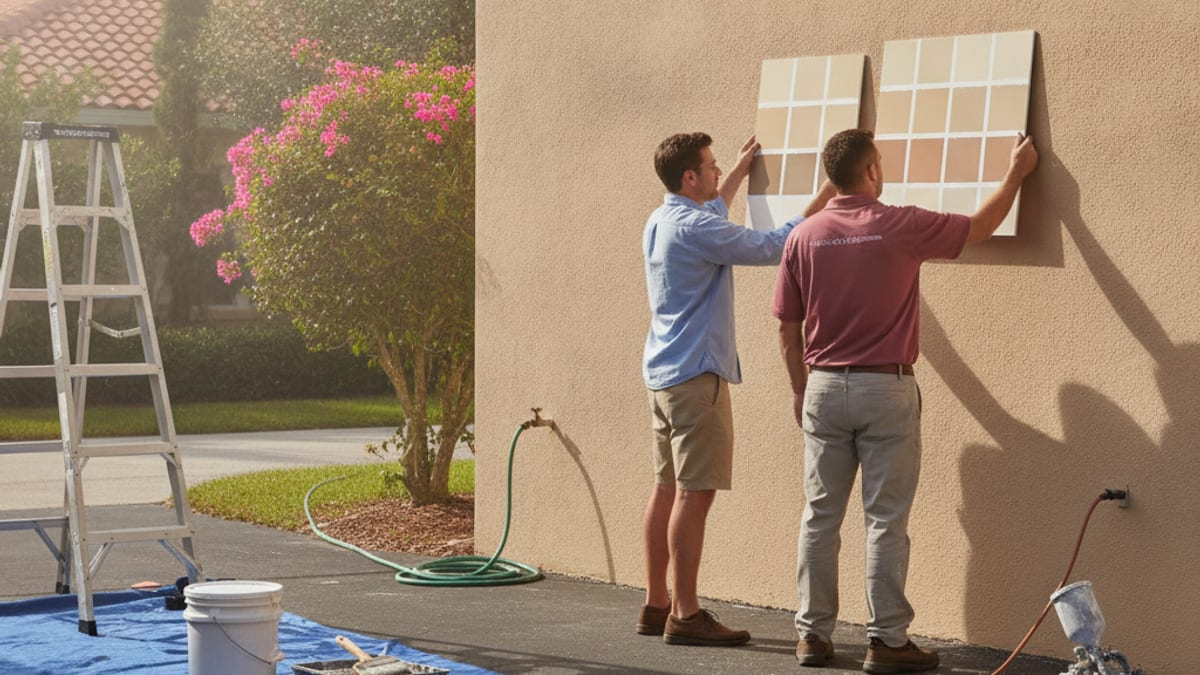
Picking an exterior color from a small paint chip inside a store and watching it look completely different once it’s covering an entire wall under Tampa’s midday sun is one of the most common regrets homeowners run into. Florida light behaves differently than the lighting most paint samples get judged under, and there are a few local rules worth knowing before you fall in love with a color.
Why Florida sun changes how colors read
Gulf-coast sunlight is more intense and more direct for more of the year than in most of the country, and that intensity shifts how a color reads on a wall compared to how it looked on a small chip. Colors generally read lighter and more saturated outdoors in strong sun than they do indoors under normal lighting, which is why a color that looked like a soft, muted sage on the chip can read almost neon-bright once it’s covering a whole south-facing wall.
This effect is strongest on south and west-facing walls, which catch the most direct afternoon sun, and weaker on north and east-facing walls, which stay in shadow more of the day. A single exterior color can genuinely look like two different shades depending on which side of the house you’re standing on, which is worth testing before committing to the whole exterior.
Test large samples in actual outdoor light
The single best thing a homeowner can do before finalizing an exterior color is paint a large sample, at least a two-foot-by-two-foot section, directly on the actual exterior wall in more than one location, and look at it across a full day. Morning light, midday sun, and late afternoon light all render the same color noticeably differently, and a color that looks right at 10 a.m. can look washed out or overly bright by 3 p.m.
A color consultation is worth the investment on a full exterior repaint, since a professional consultant has real experience with how specific color families behave under Gulf-coast light and can steer you away from colors that read well on a screen or in a showroom but disappoint once they’re on the actual house.
UV fade and finish durability
Beyond how a color initially reads, Florida’s near-constant intense UV exposure fades exterior paint faster than in milder climates, especially on south and west-facing walls that take the brunt of direct sun year-round. Darker, more saturated colors tend to show fading and chalking more visibly over time than lighter, more muted tones, simply because the contrast between the original color and the faded version is more noticeable.
Paint lines formulated with UV-resistant pigments and a higher-quality resin binder cost more per gallon but genuinely extend how long a color holds true before it needs a fresh coat, particularly important on the sun-exposed sides of the house rather than the whole exterior uniformly.
HOA approval: check before you commit
A large share of newer Tampa Bay communities, especially master-planned developments across Wesley Chapel, Land O’ Lakes, and parts of Riverview, operate under HOA architectural guidelines that require color approval before an exterior repaint, even when you’re simply refreshing the existing color rather than changing it. Some HOAs maintain an approved color palette homeowners must choose from, while others require submitting a sample or swatch for board review before work begins.
Skipping this step and painting first is a genuine risk, since some HOAs can require a repaint at the homeowner’s expense if an unapproved color goes up. Checking your community’s architectural review requirements and submitting for approval before scheduling the paint crew saves real time and money if there’s any chance your desired color falls outside the approved range.
Historic district color rules in Tampa Bay
Neighborhoods within designated historic districts, including sections of Hyde Park, Ybor City, and Tampa Heights, often fall under local historic preservation guidelines that regulate exterior color choices to maintain period-appropriate character. These rules vary by specific district and sometimes by individual property’s historic designation, and they can require submitting a color proposal to a local historic preservation board before painting.
This isn’t unique to Tampa. Historic districts across the country regulate exterior appearance to preserve neighborhood character, and Tampa Bay’s older, architecturally significant neighborhoods are no exception. If your home sits within one of these districts, checking with the city’s historic preservation office before finalizing a color choice avoids a costly do-over and keeps the project moving on schedule.
Working from a professional color deck versus outside swatches
Most painting contractors work from a specific manufacturer’s color deck they have experience mixing and applying, and there’s real value in staying within that system rather than bringing in a color matched from an unrelated source, since the contractor already knows how those specific pigments and formulations perform under sun exposure and hold up over time. If you’ve fallen in love with a color from a magazine, a neighbor’s house, or an online photo, a good contractor can usually get close within their own product line rather than trying to custom-match an unfamiliar formulation that hasn’t been tested for exterior durability in this climate.
Real examples by neighborhood style
In coastal communities like St. Pete Beach and Indian Rocks Beach, lighter, airier palettes, soft blues, warm whites, sandy neutrals, tend to suit the beach cottage architecture and also perform well against salt air and intense reflected light off nearby water. Darker colors in these areas show fading and salt residue more visibly over shorter cycles.
In established inland neighborhoods like Carrollwood and Brandon, homeowners often lean toward warmer neutrals, greiges, soft taupes, and deeper accent colors on the front door, that read as updated without standing out sharply from the surrounding streetscape. Newer master-planned communities in Wesley Chapel and Land O’ Lakes frequently have HOA-approved palettes that lean toward a curated range of coastal and craftsman-inspired neutrals designed to keep the whole community’s exterior palette cohesive.
Testing colors across different seasons
Because Florida’s sun angle and daylight hours shift meaningfully between summer and winter, a color tested only in the shorter, lower-angle light of December can read differently once June’s longer, more direct daylight hits the same wall. If your schedule allows any flexibility, viewing a large test sample across more than one season, or at minimum at both midday and late afternoon regardless of season, gives a more reliable sense of how the final color will actually look year-round rather than under one specific set of conditions.
Coordinating trim, doors, and stucco color together
Exterior color decisions rarely stop at the main wall color. Trim, front door, garage door, and any accent elements like shutters or a stucco-textured knee wall around a pool cage all need to work together as a cohesive palette rather than being chosen in isolation. A common approach pairs a neutral or muted main body color with a slightly darker trim shade and a bolder accent color on the front door, giving the home visual interest without overwhelming the overall look.
Roof color and other fixed elements to work around
A house’s roof color, whether tile, shingle, or metal, is a fixed element that isn’t changing with a repaint, and a strong exterior color scheme accounts for it rather than fighting it. A warm terracotta tile roof, common across a lot of Tampa Bay’s Mediterranean and Spanish-influenced architecture, generally pairs better with warm neutrals and earth tones than with cool grays or blues, which can create visual tension against the roofline. Taking a photo of the actual roof and bringing it along when reviewing paint samples helps confirm a color choice reads well against the elements of the home that aren’t up for discussion.
Why does my paint color look different outside than it did on the chip?
Florida’s intense, direct sunlight reads colors lighter and more saturated than typical indoor lighting used to judge paint chips. South and west-facing walls, which get the most direct sun, show this effect most strongly.
Do I need HOA approval before repainting my house?
Many Tampa Bay communities, especially newer master-planned developments, require color approval before an exterior repaint, even for a simple refresh. Check your HOA’s architectural guidelines before scheduling work.
Are there color restrictions in historic Tampa neighborhoods?
Yes. Areas within designated historic districts, including parts of Hyde Park, Ybor City, and Tampa Heights, often have preservation guidelines regulating exterior colors. Check with the local historic preservation office before finalizing a choice.
Do darker exterior colors fade faster in Florida?
Darker, more saturated colors tend to show visible fading and chalking sooner than lighter tones under Florida’s intense UV exposure, particularly on south and west-facing walls.
Not sure which color will actually work on your home? Call (813) 000-0000 and we’ll connect you with a local crew that can walk you through a color consultation, whether you’re navigating HOA rules in Wesley Chapel or historic district guidelines in Hyde Park.