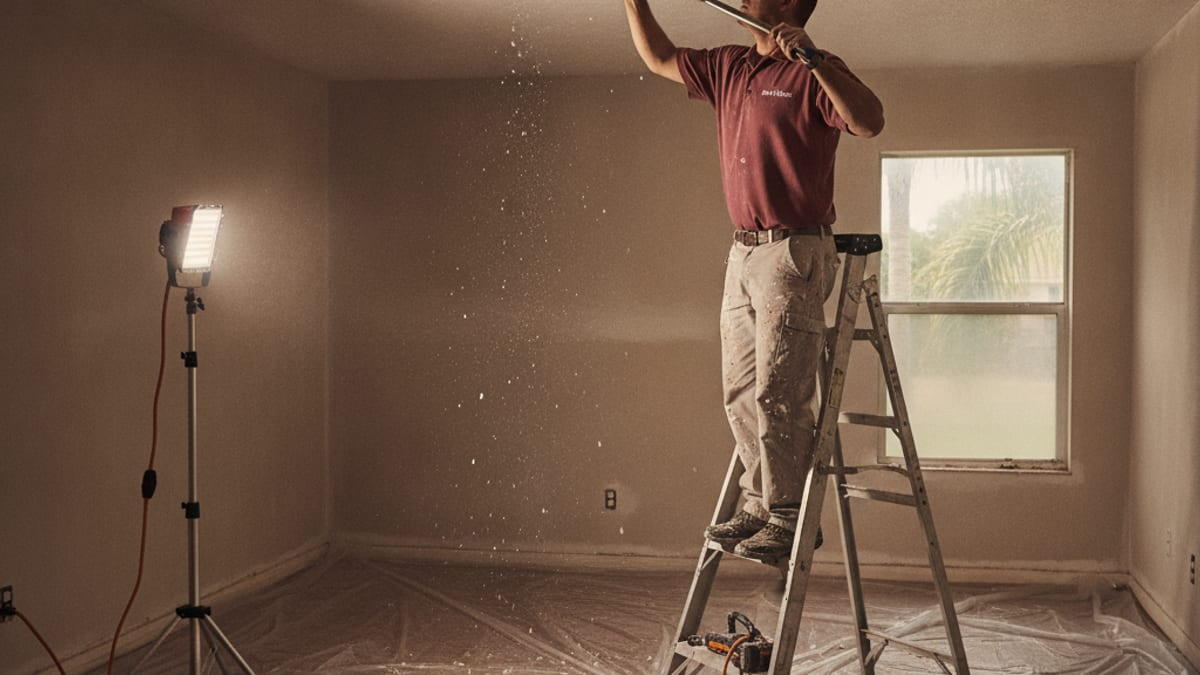
Popcorn ceilings are all over Tampa Bay’s 1970s through 1990s housing stock, especially in the tract-home neighborhoods that boomed during those decades in Brandon, Carrollwood, and Town ‘n’ Country. Most homeowners get to the point of wanting it gone the same way: it’s dated, it collects dust and cobwebs in a way flat ceilings don’t, and it makes a room feel smaller under Florida’s already lower standard ceiling heights. Here’s what removal actually costs and what changes the number.
Base pricing for popcorn ceiling removal
Removal alone, scraping the texture off and leaving a reasonably smooth surface, typically runs $1.50-$3 per square foot. A standard 12-by-14 bedroom ceiling, about 168 square feet, lands around $250-$500 for removal. A full single-story home with 1,500-1,800 square feet of ceiling runs $2,500-$5,000 for removal across the whole house.
That price covers scraping and basic cleanup, but it rarely leaves a ceiling ready for a flat or eggshell paint finish without more work, which is where the real cost usually comes in.
Why removal alone isn’t the finished product
Scraped popcorn texture almost never leaves a perfectly smooth surface underneath. Years of texture application hides minor drywall seams, nail pops, and imperfections that become visible the moment the popcorn comes off. A proper finish usually requires a skim coat, a thin layer of joint compound applied and sanded across the whole ceiling, to get a smooth, paint-ready surface.
Drywall repair and texture work for a skim coat adds $1-$2 per square foot on top of the removal cost, bringing a full single-story home’s total ceiling project to roughly $4,000-$8,500 once removal, skim coating, priming, and final paint are all included.
Asbestos: the question every homeowner should ask first
Homes built before 1980, and some built into the early 1980s before regulations fully caught up, may have popcorn texture that contains asbestos. This isn’t a scare tactic, it’s a real material fact for a meaningful slice of Tampa Bay’s older housing, including a lot of the same Brandon, Seminole Heights, and older Pinellas neighborhoods where popcorn ceilings are most common.
Before any scraping begins on a home built before the early 1980s, a sample should be tested by a certified lab. Disturbing asbestos-containing texture through dry scraping releases fibers into the air, which is a genuine health risk, not a technicality. If a sample comes back positive, the removal needs to go through a certified abatement contractor following proper containment procedures, not a standard painting crew. This adds cost and time, but it’s not a step worth skipping or guessing on.
What a positive asbestos test changes about the project
If testing confirms asbestos, homeowners generally have two paths: certified abatement removal, which runs meaningfully higher than standard scraping due to containment and disposal requirements, or encapsulation, where a skim coat or specialized covering seals the existing texture in place without disturbing it. Encapsulation is often the more affordable route and avoids the disposal and containment costs of full abatement, though it doesn’t eliminate the material, it seals it.
Either way, this is a decision to make with real test results in hand, not a guess based on the home’s build year alone, since some homes got popcorn texture applied or reapplied later in a renovation using asbestos-free material.
Ceiling condition and what adds cost
Water stains from a past roof leak or plumbing issue are common under Florida’s storm patterns, and any stained area needs a stain-blocking primer before finish paint, or the stain bleeds right back through. If a leak caused actual sagging or soft drywall, that section needs to be cut out and replaced, not just skimmed over, which adds material and labor cost that a standard quote won’t include until someone’s actually up on a ladder looking closely.
Textured “popcorn” that was painted over at some point, rather than left raw, is often harder to remove cleanly, since the paint film seals the texture and resists the standard water-and-scrape method. This can add time and sometimes requires a different removal approach, which a contractor should flag during the estimate rather than discover mid-project.
Real numbers by neighborhood and home age
Brandon, Carrollwood, and Town ‘n’ Country, all built out heavily during the popcorn ceiling era of the 1970s through 1990s, see this request constantly, and a typical single-story ranch-style home in these areas with 1,600-1,900 square feet of ceiling commonly runs $4,500-$8,000 for full removal, skim coating, and paint once everything is included.
Newer construction from the 2000s onward, common across Wesley Chapel and parts of Riverview, generally skipped popcorn texture in favor of a smooth or lightly textured “knockdown” ceiling finish from the start, so this is much less of an issue in those neighborhoods. Homes built in that era that do have some texture usually have a lighter, more modern texture that’s faster and cheaper to smooth than heavy older popcorn.
What a typical project day looks like
Most crews start by covering flooring and furniture completely, then lightly mist the ceiling with water to soften the texture before scraping, which reduces airborne dust significantly compared to dry scraping. Once the texture is off, the ceiling gets inspected for any water stains, cracks, or damage that needs addressing before the skim coat goes on.
The skim coat itself typically needs two to three thin passes with drying and light sanding between each to reach a genuinely smooth, professional-looking result, rather than one thick coat that shows roller or trowel marks once painted. Rushing this step is the most common reason a “smooth” ceiling still shows visible texture or seams once the light hits it at an angle after painting.
Combining ceiling work with other projects
Since removing popcorn ceiling texture already means covering the whole room and dealing with dust and debris, a lot of homeowners use the opportunity to handle other ceiling and upper-wall work at the same time, whether that’s drywall repair for an unrelated crack or water stain, updating a light fixture, or repainting the walls to match the newly smooth ceiling. Bundling this work into one project avoids paying for separate setup and cleanup twice.
Timing and scheduling around a Florida home
Ceiling work generates a lot of dust and debris even under good containment, so most crews recommend clearing furniture and covering flooring completely, and a lot of homeowners choose to schedule this work room by room around actual use of the house rather than doing the whole home at once. Interior work like this is season-agnostic in Florida, unlike exterior painting, so it’s a solid project to schedule during the hottest or stormiest months when outdoor work isn’t practical anyway.
Lighting changes after a smooth ceiling
A flat, smooth ceiling reflects light differently than a heavily textured popcorn surface, which tends to scatter and diffuse light unevenly. Homeowners often notice rooms feel visibly brighter after removal simply because a smooth ceiling bounces ambient and fixture light around more evenly. This is worth keeping in mind when choosing ceiling paint sheen too, since a flat white on a smooth ceiling generally looks cleaner and more uniform than the same flat finish did over textured popcorn, where shadows from the texture itself used to hide minor imperfections that now show more clearly on a smooth surface under raking light from windows or recessed fixtures.
How much does popcorn ceiling removal cost in Tampa?
Basic removal runs $1.50-$3 per square foot. A full single-story home typically costs $2,500-$5,000 for removal alone, or $4,000-$8,500 once skim coating, priming, and paint are included for a finished, smooth ceiling.
Do I need to test for asbestos before removing popcorn ceilings?
If your home was built before the early 1980s, yes. A certified lab test before scraping begins is the responsible step, since disturbing asbestos-containing texture releases fibers into the air.
What happens if the test comes back positive for asbestos?
You’ll generally choose between certified abatement removal or encapsulation, which seals the existing texture in place with a skim coat rather than disturbing it. Encapsulation is often the more affordable option.
Is removal alone enough, or do I need a skim coat too?
Removal alone rarely leaves a smooth, paint-ready surface, since years of texture hide seams and imperfections underneath. Most homeowners need a skim coat for a genuinely finished look.
If you’re ready to get rid of a dated ceiling, call (813) 000-0000 and we’ll connect you with a local crew that handles testing questions honestly, whether you’re in Carrollwood or anywhere else across Tampa Bay.