A full kitchen remodel and a cabinet refinish can produce a nearly identical visual result for wildly different money, and most homeowners never get a straight comparison of the two before picking one. Here’s what actually separates them, cost-wise and outcome-wise, for a Tampa Bay kitchen.
The two paths, side by side
Refinishing means painting or professionally finishing your existing cabinet boxes and doors in place, keeping the underlying structure, layout, and often the hardware. Replacement means tearing out the old cabinets entirely and installing new boxes, doors, and hardware, sometimes with a new layout.
For a typical Tampa Bay kitchen, 15-25 linear feet of cabinets, cabinet painting and refinishing runs $3,500-$7,500 depending on cabinet count, door style, and finish quality. Full cabinet replacement for the same footprint, even at the mid-range rather than custom-built level, typically runs $12,000-$25,000 once you include demo, new boxes, installation, and often some electrical or plumbing rework around the sink and appliances.
Why the gap is so wide
Refinishing is almost entirely labor and material cost on cabinets you already own. There’s no manufacturing lead time, no new box construction, and no need to touch the plumbing, electrical, or flooring underneath, since the footprint doesn’t change. A crew sands or preps the existing surfaces, sprays or hand-finishes a durable coating, and reinstalls doors and hardware, usually finishing in 5-10 days depending on kitchen size.
Replacement involves ordering new cabinet boxes, which for anything beyond stock big-box sizing runs 4-8 weeks of lead time before installation even starts. Then there’s demolition, disposal, new box installation, and frequently discovering the wall or floor behind 20-year-old cabinets needs some repair once they come out, which adds cost that’s hard to quote precisely upfront.
When refinishing is the right call
If the cabinet boxes are structurally sound, the layout works for how you actually use the kitchen, and the main issue is dated color, worn finish, or scuffed doors, refinishing solves the problem for a third to half the cost of replacement. This is especially true for solid wood cabinet boxes from the 1990s and 2000s that are common across Brandon, Carrollwood, and Town ‘n’ Country tract homes. The boxes underneath are often better built than what gets installed in a lot of budget-tier new construction today.
Refinishing also makes sense as a pre-sale move. A dated oak or honey-stained kitchen reads as an immediate remodel project to a buyer, and a fresh painted finish in a current color, often a warm white, greige, or deep navy on an island, changes that perception for a fraction of what a full remodel would cost, with a return that generally outpaces the investment at resale. Pairing a refinish with a quick color consultation helps land on a shade that photographs well and matches how strong Gulf-coast light hits the room at different times of day.
When replacement is worth the extra cost
Refinishing can’t fix a layout that doesn’t work, cabinet boxes with water damage or termite history, or a kitchen that needs more storage or counter space than the current footprint provides. If you’re adding an island, reconfiguring where the sink or range sits, or dealing with particleboard boxes that have swollen or delaminated from years of Florida humidity, replacement is the honest answer even though it costs more.
Water damage under a sink or dishwasher is worth checking closely before committing to refinishing. Swollen particleboard doesn’t refinish well and tends to keep failing even under a fresh coat, so a contractor should flag that during an in-home estimate rather than after the job starts.
What a refinish actually involves
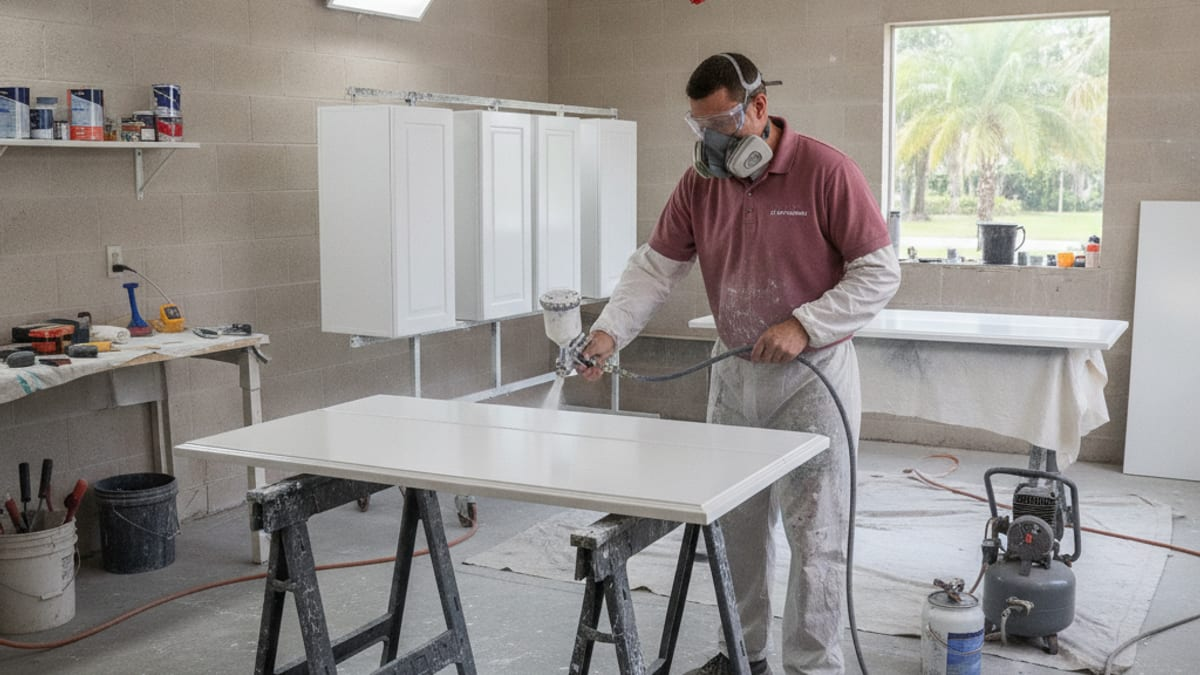
A proper cabinet refinish isn’t a quick coat of paint over existing finish. Doors and drawer fronts typically come off and get sprayed in a controlled environment for a smoother, more durable finish than what’s achievable brushing in place. Boxes get scuffed, cleaned, and hand-finished in place since they can’t be removed from the kitchen.
Hardware gets swapped or reused depending on the look you’re going for, and this is a relatively cheap way to modernize the overall feel without touching the cabinets themselves. New hinges, especially soft-close upgrades, are a common add-on during a refinish since the doors are already off and accessible.
Durability: how a refinish holds up in a Florida kitchen
A quality cabinet refinish using a proper catalyzed or hybrid enamel, not a standard wall paint, holds up well to daily kitchen use, including grease, humidity, and regular cleaning, typically lasting 10-15 years before it needs attention again. The finish quality matters more here than in almost any other painting application in the house, since cabinets get touched, wiped, and bumped constantly.
Kitchens near the coast or in homes without strong exhaust ventilation deal with more ambient humidity around the stove and sink, which is worth mentioning to your contractor so the finish coat gets the right cure time and, where appropriate, a more moisture-tolerant product line.
Hidden costs on both paths
Refinishing has fewer surprises than replacement, but a couple of things can still add to the estimate. If the existing doors have damage beyond surface wear, cracked panels or warped MDF doors that swelled from years of humidity near the sink or dishwasher, those specific doors may need replacement rather than refinishing even within an otherwise straightforward refinish project. Hardware holes that don’t line up with new pulls or handles also need filling and redrilling, a small but real add-on.
Replacement carries bigger hidden-cost risk. Once old cabinets come out, it’s common to find the wall behind them needs patching, the flooring underneath doesn’t match what’s visible around the edges, or the countertop needs to be removed and reset, sometimes replaced entirely if it doesn’t fit the new box dimensions. These discoveries are hard to price accurately until demo actually happens, which is part of why replacement quotes tend to include contingency language that a refinishing quote usually doesn’t need.
Resale value: which one buyers actually notice
Real estate agents in the Tampa Bay market generally agree that a clean, modern-looking kitchen matters more to buyers than whether the cabinets are original or replaced, as long as the finish looks current and well-executed. A professional refinish in a popular current color, done with a durable catalyzed finish rather than a quick DIY paint job, reads as a fully updated kitchen to most buyers walking through during a showing.
Full replacement obviously reads as more comprehensively new, and it can support a slightly higher perceived value in a competitive listing, but the return on that additional investment doesn’t always outpace what a refinish delivers per dollar spent, particularly in a mid-range home rather than a high-end listing where buyers expect custom cabinetry as a baseline.
What a typical estimate visit looks like
For either path, a proper in-home estimate should include the contractor physically checking cabinet box condition, opening doors and drawers to check for water damage or delamination, and asking how you actually use the kitchen day to day. If storage or workflow complaints come up during that conversation, that’s often the signal that refinishing alone won’t solve the underlying problem, and a partial reconfiguration or full replacement deserves a serious look instead of assuming refinishing is automatically the budget-friendly right answer.
Getting an honest recommendation
The most useful thing a contractor can do during an in-home estimate is tell you honestly whether your specific cabinets are good refinishing candidates, not just quote whichever job pays more. Solid wood boxes in good structural shape, a layout you’re happy with, and no water damage are the green lights. If any of those are missing, a straight answer about replacement, even though it’s the more expensive recommendation, is worth more than a refinish quote on cabinets that won’t hold the finish.
Is cabinet refinishing cheaper than replacement?
Yes, significantly. Refinishing a typical Tampa Bay kitchen runs $3,500-$7,500, while full replacement for the same footprint typically runs $12,000-$25,000 once demo, new boxes, and installation are included.
How long does cabinet refinishing take compared to replacement?
Refinishing usually takes 5-10 days. Replacement typically takes several weeks once you factor in 4-8 weeks of lead time for new cabinet boxes plus demolition and installation.
Can water-damaged cabinets be refinished?
Not reliably. Swollen or delaminated particleboard from water exposure, common under sinks and dishwashers, doesn’t hold a finish well even after refinishing. This usually points toward replacement instead.
How long does a cabinet refinish last?
A properly done refinish with a durable catalyzed or hybrid enamel typically lasts 10-15 years with normal kitchen use before it needs attention again.
If you’re weighing refinishing against a full remodel, call (813) 000-0000 and we’ll connect you with a local crew for an honest, in-home evaluation of your cabinets before you commit to either direction.