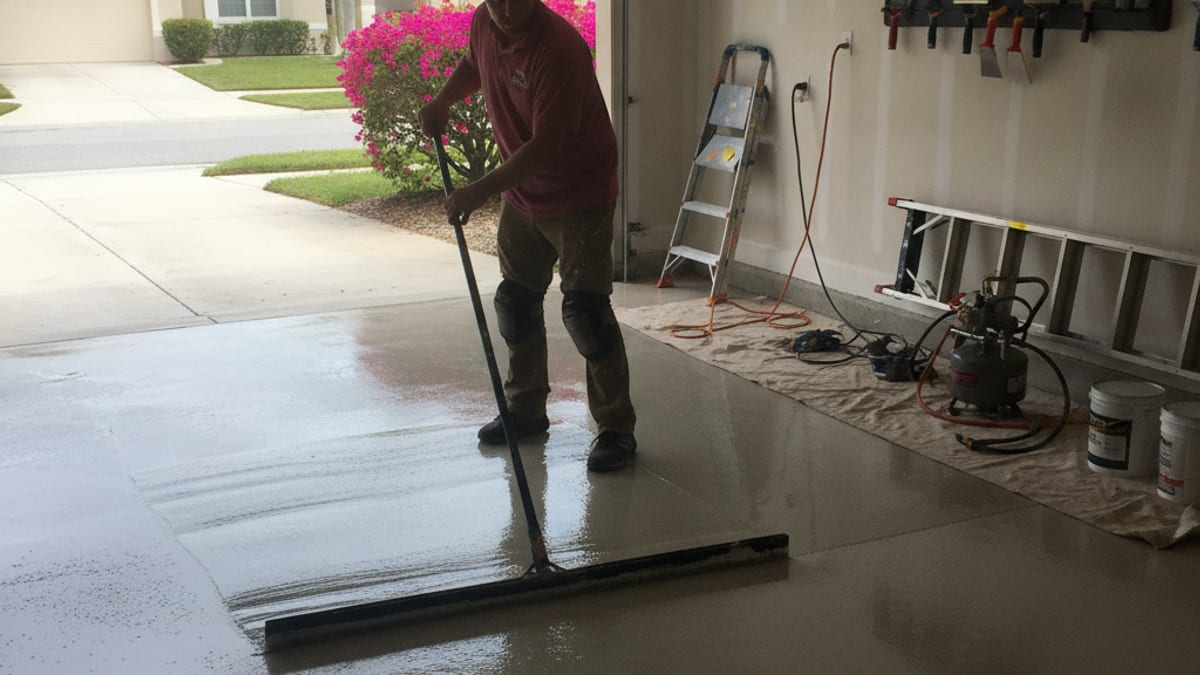
Garage floor epoxy has become one of the more popular upgrade requests in Tampa Bay, and for good reason: a plain gray concrete slab that’s absorbed years of oil stains, tire marks, and humidity discoloration transforms into something that looks intentional and holds up to daily use. Here’s what it actually costs and the one technical risk that matters more here than almost anywhere else in the country.
Base pricing for garage floor epoxy
A standard two-car garage, roughly 400-500 square feet, typically runs $2,000-$4,500 for a professional epoxy coating including surface prep, the epoxy base coat, and a top coat. That works out to roughly $4-$9 per square foot depending on the system used and how much prep the existing slab needs.
A three-car garage or larger, common in newer construction across Wesley Chapel and FishHawk, scales up proportionally, typically $6,000-$10,500 for a full high-quality install. Decorative flake systems, where colored vinyl chips get broadcast into the wet epoxy for texture and additional durability, run toward the higher end of that range compared to a solid-color finish.
Why moisture testing matters more in Florida than most places
This is the single most important technical step in a Florida garage floor epoxy job, and it’s the one corner that shouldn’t get cut. Slab-on-grade foundations, standard construction across nearly all of Tampa Bay, sit directly on the ground, and Florida’s high water table and near-constant humidity mean moisture vapor transmission through that slab is a real and ongoing phenomenon, not a rare edge case.
Epoxy is essentially a plastic film sealing the concrete surface. If moisture vapor is pushing up through the slab from below at a rate the coating wasn’t designed to handle, that moisture gets trapped between the concrete and the epoxy layer, and the coating fails from underneath, bubbling, delaminating, or peeling away from the slab, sometimes within months rather than years.
A proper moisture vapor test, using a calcium chloride test or an in-situ relative humidity probe, measures how much moisture is moving through the slab before any coating goes on. If moisture levels exceed what a standard epoxy system can tolerate, the job needs a moisture-mitigating primer or a different coating system entirely, and skipping this test to save time or money is the leading cause of epoxy failure in Florida garages.
Surface prep: the other half of a durable job
Beyond moisture testing, the slab needs mechanical prep, typically diamond grinding, to open the concrete’s pores and create a surface the epoxy can genuinely bond to rather than just sitting on top of. Acid etching alone, a cheaper and faster prep method some lower-cost jobs use, produces a weaker bond than mechanical grinding and is more likely to fail under a car’s weight and regular foot traffic over time.
Cracks and expansion joints in the slab need to be addressed before coating, either filled or accounted for in the coating pattern, since an uncontrolled crack under epoxy tends to telegraph through the coating and can widen the failure point over time.
Humidity’s effect on cure time and application window
Epoxy has a specific temperature and humidity range for proper application and cure, and Florida’s summer humidity can push outside that window on the most extreme days, particularly in an unconditioned garage. Most professional crews schedule around this, checking conditions before application and sometimes using dehumidifiers in the garage during the curing window to keep humidity within range, since epoxy applied outside its ideal conditions can cure with a hazy finish, uneven texture, or reduced durability.
DIY kits versus a professional install
Big-box DIY epoxy kits are tempting given their lower upfront cost, often a few hundred dollars for a two-car garage’s worth of material, but they skip the two things that matter most for long-term durability in Florida: proper moisture testing and mechanical surface prep. Most DIY kits rely on a simple acid-etch prep step done by hand, which produces a meaningfully weaker bond than professional diamond grinding, and they don’t include any moisture vapor testing at all.
The result is that a lot of DIY epoxy jobs in Florida garages look great for the first several months and then start peeling, especially near the garage door where moisture intrusion and temperature swings are most extreme. A professional install costs more upfront but addresses the actual failure points that are specific to Florida’s slab conditions, which is where the real value difference lies, not just the quality of the epoxy product itself.
How long the process takes
A professional garage floor epoxy job typically takes two to four days from start to finish for a standard two-car garage, including moisture testing, grinding, crack repair if needed, the base coat, and the top coat, with proper cure time between each step. The garage generally needs to stay clear of vehicle traffic for at least 24-72 hours after the final coat, depending on the specific product’s cure requirements, and light foot traffic sooner than that in most cases.
Humidity can extend this timeline slightly compared to drier climates, which is part of why an experienced local crew builds in appropriate buffer time rather than promising a rushed same-week turnaround that risks the final cure.
Choosing between solid color and flake systems
A solid-color epoxy finish gives a clean, uniform look and is generally the more affordable option, while a decorative flake system, with colored vinyl chips broadcast into the wet epoxy, adds visual texture, hides minor imperfections and future scuffs better, and typically adds some slip resistance, a genuine practical benefit in a garage that sees water tracked in during Florida’s rainy season. Flake systems cost more due to the additional material and labor of broadcasting and later top-coating over the chips, but a lot of homeowners find the added durability and forgiving appearance worth the upcharge for a space that gets daily use.
Comparing epoxy to other garage floor options
Epoxy isn’t the only coating option, but it’s generally the most durable and cost-effective for the level of protection it provides against oil, chemicals, and daily wear in a Florida garage. Polyaspartic coatings, a newer alternative, cure faster and resist UV yellowing slightly better, useful for a garage that gets direct sunlight through an open door regularly, but typically cost somewhat more than standard epoxy systems.
For homeowners weighing whether a full epoxy system is worth it versus simply repainting a garage floor, epoxy provides genuine chemical and abrasion resistance that standard interior painting products aren’t formulated for, which is the real value difference beyond just appearance.
Commercial and small business applications
Small business owners with a garage-adjacent workspace, a home-based auto business, or a light commercial shop also request epoxy flooring regularly across Tampa Bay, and the same moisture testing and prep standards apply regardless of whether the space is residential or commercial. A higher-traffic commercial floor often benefits from a thicker epoxy system or additional top coats for extended durability under daily foot and equipment traffic.
Caring for an epoxy floor after installation
A properly cured epoxy floor is genuinely low-maintenance, but a few habits extend its life meaningfully. Placing a mat or tray under a vehicle’s typical parking spot catches oil drips and road salt residue before they sit directly on the coating for extended periods. Sweeping regularly and mopping with a mild cleaner, rather than harsh solvents, keeps the surface looking new without degrading the coating’s finish over time.
Hot tire pickup, where a vehicle’s warm tires can occasionally lift a small area of coating if the floor hasn’t fully cured before regular use begins, is another reason the recommended cure window before vehicle traffic matters. Respecting that timeline in the days right after installation prevents an avoidable early repair.
How much does garage floor epoxy cost in Tampa Bay?
A standard two-car garage typically runs $2,000-$4,500. A three-car garage or larger runs $6,000-$10,500 for a full high-quality install, with decorative flake systems toward the higher end.
Why does moisture testing matter so much for Florida garages?
Florida’s high water table and humidity mean moisture vapor regularly moves through slab-on-grade foundations. Without testing, trapped moisture under the coating causes it to bubble, delaminate, or peel, often within months rather than years.
What happens if a garage floor has high moisture readings?
The job typically needs a moisture-mitigating primer or a different coating system designed to handle higher vapor transmission, determined by the test results before any coating goes on.
Is epoxy better than just painting a garage floor?
For durability against oil, chemicals, and daily wear, yes. Epoxy provides chemical and abrasion resistance that standard paint isn’t formulated to handle over the long term.
Ready to get your garage floor coated the right way? Call (813) 000-0000 and we’ll connect you with a local crew that starts with a proper moisture test, not just a coat of epoxy.