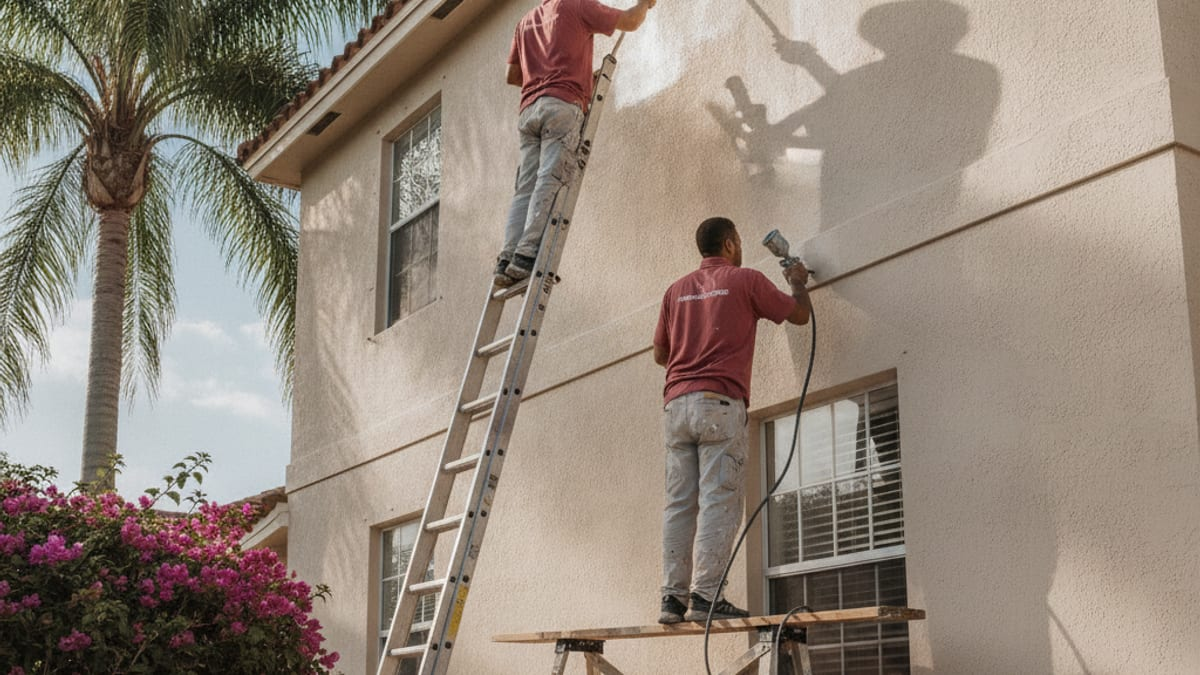
Exterior painting quotes in Tampa Bay vary more than interior quotes do, mostly because the surface itself matters so much here. A stucco-over-block home in South Tampa prices differently than a wood-sided cottage in Old Seminole Heights, and a place two blocks from the Gulf carries maintenance costs that an inland home in Plant City never has to think about. Here’s what actually goes into the number.
Stucco versus siding: the biggest cost factor
Most Tampa Bay homes are stucco over concrete block, which is a different job than painting wood or fiber-cement siding. Stucco is porous and holds onto dirt, mildew, and chalking paint residue, so it usually needs a more thorough pressure wash and, in a lot of cases, crack repair before a single coat goes on. Expect $3-$5.50 per square foot of exterior surface for a full stucco repaint including standard prep, versus $2.50-$4.50 per square foot for siding in comparable condition.
Homes with a mix of stucco and wood or vinyl trim, common in a lot of Brandon and Riverview tract construction, price somewhere between those numbers, since the crew is managing two different surface preparations on one job.
Real numbers by home size
A single-story 1,500-square-foot home with roughly 1,800-2,200 square feet of exterior wall surface typically runs $4,500-$8,500 for a full repaint, including standard prep and two coats. A larger two-story home, 2,800 square feet and up, often lands in the $9,000-$16,000 range, since two-story exteriors need lift equipment or extensive ladder work that adds both time and insurance cost to the labor rate.
Detached garages, screened lanais with painted surfaces, and pool cages with stucco knee walls all add to the total if they’re included in the scope, and it’s worth clarifying upfront whether a quote covers the whole exterior footprint or just the main house walls.
Prep work: where stucco homes get expensive
Hairline stucco cracking is close to universal in Tampa Bay’s older housing stock, driven by slab movement, humidity cycling, and decades of hurricane-season wind load. Stucco crack repair before painting isn’t optional cosmetic work. Painting over an active crack seals in moisture behind the surface, and the paint film fails at that crack line within a season or two, sometimes faster.
Minor hairline cracks typically add $200-$600 to a project for patching and re-texturing. Larger cracks, especially ones that suggest structural movement rather than surface shrinkage, cross into work that may fall under a CBC or CRC-licensed contractor’s scope in Florida. If a crack looks like more than surface-level stucco shrinkage, it’s worth verifying the contractor’s license status at myfloridalicense.com before signing off on repair work, separate from the standard painting crew.
Mildew and pressure washing: not optional here
Year-round humidity and near-daily afternoon storms in summer mean mildew and algae growth on north-facing walls and shaded stucco is close to universal across Tampa Bay, not an occasional problem. Pressure washing before any exterior repaint removes that buildup along with chalking old paint, dirt, and pollen, and it’s a near-mandatory prep step here in a way that’s optional in drier climates. Skipping it means new paint bonds to a dirty, unstable surface and fails early.
A mildew-resistant additive in the finish coat is worth the small upcharge on most Tampa Bay exteriors, particularly on the shaded north and east-facing walls that stay damp longest after a storm.
Salt air and coastal repaint cycles
Homes within a mile or two of the Gulf, think St. Pete Beach, Indian Rocks Beach, or Tierra Verde, deal with a repaint cycle that inland homes simply don’t. Salt-laden air accelerates paint breakdown, particularly on the side of the house facing the water, and coastal properties often need a fresh coat every 5-7 years compared to 8-12 years for an inland home in Land O’ Lakes or Plant City.
Marine-grade or salt-resistant exterior paint lines cost more per gallon but genuinely extend the interval between repaints for beachfront and near-beach properties, and the upcharge is worth discussing directly if you’re within sight of the water.
Timing around hurricane season and humidity cure
Exterior painting works best scheduled outside the heart of hurricane season, June through November, when possible, both because of storm risk to a fresh job and because Florida’s summer humidity slows dry and cure times significantly compared to the label. A paint that touch-dries in an hour in a lab test might need three to four hours here in July before it can handle rain, and full cure to final hardness often takes two to three weeks rather than the standard week.
The dry season, roughly November through April, gives paint more consistent cure conditions and lower risk of an afternoon downpour interrupting a fresh coat mid-application, which is why a lot of experienced Tampa Bay crews book up fastest in those months.
Trim, doors, and garage doors: the line items a base quote might skip
A full exterior repaint quote should specify exactly what’s included beyond the main wall surface. Fascia boards, soffits, window trim, and garage doors are sometimes priced separately from the main body of the house, and a low quote that looks great on paper can turn out to exclude several of these elements, only for them to show up as an add-on once the crew is on site.
Front doors in particular are worth a specific conversation, since a lot of homeowners want a bold accent color on the door that differs from the rest of the trim palette, and that sometimes requires a different, higher-gloss product than what’s used on the main trim.
What a phone estimate can’t tell you
No experienced exterior painter should give a firm number over the phone without seeing the property, and that’s not a stalling tactic, it’s a function of how much square footage, surface condition, and prep work varies from house to house even among similar-sized homes. A 1,500-square-foot home with heavy existing stucco cracking and mildew buildup costs meaningfully more to prep than the same size home in good condition, and that difference only shows up during an in-person walk-around.
The crews we connect homeowners with measure the actual exterior square footage, assess crack severity, check for mildew and chalking, and look closely at trim and door condition before quoting a final number, which is the only way to get pricing that holds once the job starts rather than growing with change orders.
Real numbers by neighborhood
In older, established neighborhoods like Hyde Park and Old Seminole Heights, homes often have more architectural detail, taller first-floor ceilings, and sometimes a mix of stucco and original wood trim, which pushes a full exterior repaint toward $6,500-$11,000 depending on square footage and detail level.
In newer, more standardized construction across Wesley Chapel, Land O’ Lakes, and parts of Riverview, simpler trim profiles and more uniform stucco surfaces tend to keep costs closer to $4,500-$8,000 for a comparable-sized home, assuming the stucco is in reasonably good condition without extensive crack repair needed.
Warranty expectations on exterior work
Most established painting crews back a full exterior job with some form of workmanship warranty, typically two to five years, covering issues like peeling, bubbling, or premature failure tied to application or prep problems rather than normal wear over time. It’s worth asking specifically what the warranty covers and for how long before signing a contract, since coverage varies significantly between crews and a longer warranty is often a genuine signal of confidence in the prep and application process rather than just marketing language.
Manufacturer paint warranties are separate from workmanship warranties and typically cover product defects in the paint itself, not application issues. Understanding which warranty applies if something goes wrong down the line, and getting that in writing, saves a lot of frustration compared to assuming coverage that isn’t actually there.
How much does exterior painting cost in Tampa Bay?
A full exterior repaint typically runs $3-$5.50 per square foot for stucco or $2.50-$4.50 per square foot for siding. A 1,500-square-foot single-story home usually lands in the $4,500-$8,500 range, with larger two-story homes running $9,000-$16,000.
Do I need stucco crack repair before painting?
If your stucco has visible cracking, yes. Painting over active cracks traps moisture and causes early paint failure. Minor cracks typically add $200-$600 to a project, while larger cracks may need a licensed contractor’s evaluation.
How often do coastal homes need repainting?
Homes within a mile or two of the Gulf, particularly in beach communities, often need repainting every 5-7 years due to salt air exposure, compared to 8-12 years for inland Tampa Bay homes.
When is the best time of year to paint an exterior in Florida?
Outside of hurricane season, roughly November through April, gives the most reliable cure conditions and the lowest risk of storms interrupting a fresh coat. Interior work stays a solid option year-round.
Ready for a real quote on your home’s exterior? Call (813) 000-0000 and we’ll connect you with an insured local crew for a free estimate, whether you’re inland in Riverview or facing salt air out toward St. Pete Beach.