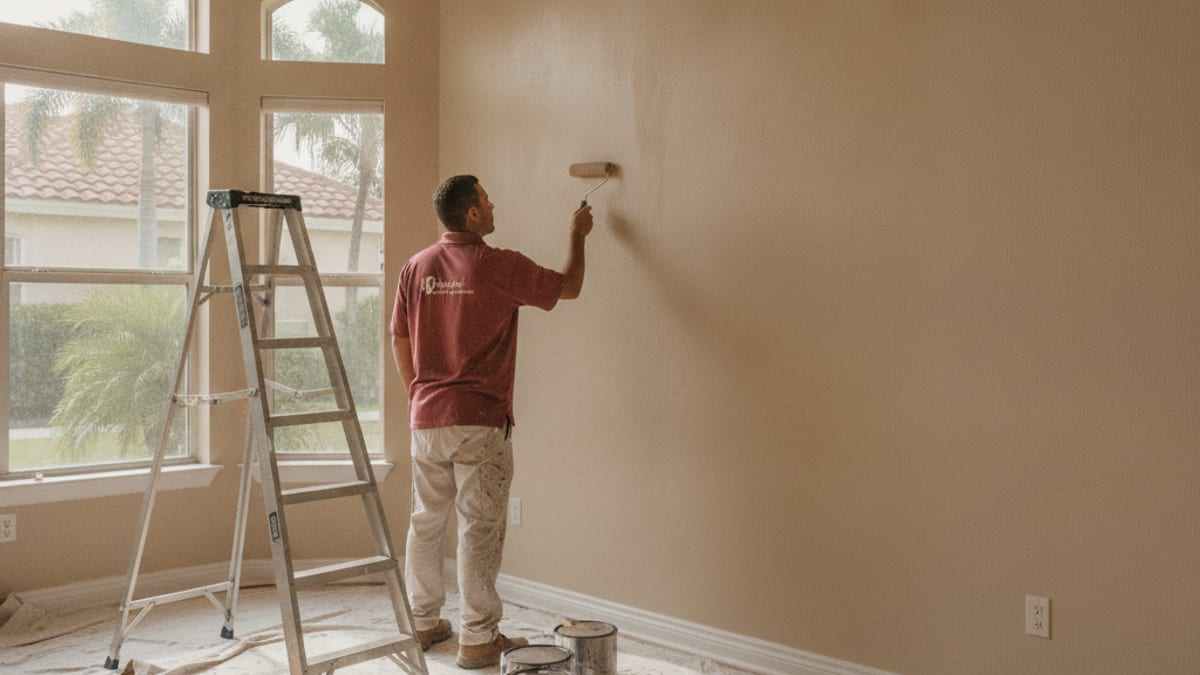
Getting three interior painting quotes in Tampa and watching them land $2,000 apart isn’t unusual, and it’s rarely a sign someone’s overcharging. Room size, ceiling height, paint grade, and how much prep the walls actually need all move the number more than most homeowners expect. Here’s what actually drives the price, with real ranges pulled from typical Tampa Bay jobs.
What drives the price per square foot
Most interior painters price by the room or by square footage of wall space, not by the hour, and the baseline usually runs $2.50-$4.50 per square foot of wall space for a standard job. A 12-by-14 bedroom with 8-foot ceilings works out to roughly 400 square feet of wall, which lands most quotes in the $1,000-$1,800 range including one coat of primer and two coats of finish paint.
Ceiling height changes the math fast. A lot of Tampa homes, especially anything built since the 2000s in areas like FishHawk or Wesley Chapel, have 9 or 10-foot ceilings or vaulted great rooms, and every extra foot adds labor and often requires scaffolding or extension equipment that a standard 8-foot room doesn’t need.
Real numbers by room and home size
A single bedroom typically runs $350-$700 for labor and materials. A full living room or great room, especially the vaulted ones common in newer Pasco County builds, runs $600-$1,500 depending on square footage and trim detail. Kitchens and bathrooms cost more per square foot because of cutting in around cabinets, tile, and fixtures, usually $400-$900 even in a modest-sized room.
For a whole interior repaint, a 1,500-square-foot single-story home in Brandon or Riverview commonly lands in the $3,500-$6,000 range. A larger two-story home, 2,800 square feet and up, with multiple bedrooms and a stairwell, often runs $7,000-$12,000. Stairwells and two-story foyers add real cost because of the equipment needed to reach 18 or 20-foot walls safely.
Paint grade: why the can matters as much as the labor
Paint quality is one of the biggest swings in a quote that homeowners tend to underweight. A builder-grade flat paint might run $30 a gallon, while a premium washable eggshell or satin from a line built for high-traffic homes can run $65-$80 a gallon. On a whole-house job that’s a few hundred dollars of material cost difference, but the coverage, durability, and touch-up behavior over the next five to ten years is where it actually pays off.
Florida’s humidity makes this more than a cosmetic choice. Bathrooms, kitchens, and laundry rooms benefit from a mildew-resistant additive built into the paint itself rather than relying only on ventilation, since year-round humidity gives mold and mildew a real foothold on interior walls in ways drier climates don’t deal with.
Prep work that changes the estimate
Prep is where a quote can jump without the homeowner understanding why. Patching nail holes and minor drywall dings is baked into most standard quotes, but heavier repair work like drywall repair and texture matching after removing shelving, TVs, or old built-ins gets priced separately.
Wallpaper is its own category. A lot of older homes in Seminole Heights and Hyde Park still have original or previous-owner wallpaper in at least one room, and wallpaper removal before painting can add $2-$4 per square foot depending on how well the glue releases from the wall. Stripping wallpaper wrong tears the underlying drywall paper, which then needs a skim coat before paint goes on, so this step is worth budgeting for honestly rather than treating as an afterthought.
Older Tampa homes and lead paint: what to ask before work starts
Any home built before 1978 carries a real chance of lead-based paint somewhere in the layers, particularly in trim, doors, and window casings that haven’t been fully repainted since. Seminole Heights, Hyde Park, Ybor City, Tampa Heights, and older pockets of St. Petersburg all have significant pre-1978 housing stock.
Federal EPA RRP rules require lead-safe work practices whenever paint is disturbed on a pre-1978 home, and a homeowner is well within reason to ask a contractor directly whether they’re certified for lead-safe practices before signing anything. This isn’t a box-checking exercise. Improper sanding or scraping of lead paint creates dust that’s genuinely hazardous to kids and pregnant women in the household. If you’re unsure whether your home has lead paint, a certified inspector can test it before the crew shows up, and that’s a smarter first step than assuming either way.
Humidity and cure time: why Florida timelines run longer
Paint manufacturers print dry times based on lab conditions that don’t match a Tampa house in July. High ambient humidity slows evaporation, which means the touch-dry window most cans list as one to two hours can stretch to three or four hours indoors without strong air conditioning and airflow running during the job. Full cure, the point where paint reaches its final hardness and washability, takes longer here too, often a full two to three weeks rather than the standard week quoted on the label.
That matters for scheduling around real life. If you’re painting before a move-in date or before furniture goes back in a room, build in a few extra days of buffer beyond what the can says, especially in the humid stretch from June through September.
Real numbers by neighborhood and home style
In South Tampa neighborhoods like Palma Ceia and Davis Islands, homes tend to have taller ceilings, more crown molding, and formal dining rooms with detailed trim work, all of which push labor time up. A whole-interior repaint in these areas commonly runs $6,000-$11,000 given the added trim detail and larger average room sizes.
In newer construction across FishHawk, Wesley Chapel, and parts of Riverview, ceilings run higher too, often 9 or 10 feet on the main floor, but the trim tends to be simpler and more standardized, which keeps labor closer to the $3,500-$6,500 range for a comparable-sized home.
Older bungalows in Seminole Heights and Tampa Heights often have smaller individual rooms but more of them, plus original wood trim and window casings that need careful cutting in rather than a quick roll-and-go approach, which can push labor time up even on a smaller overall square footage.
Choosing sheen by room, not just color
Sheen matters as much as color for how a room performs over time, and it’s a decision worth making room by room rather than picking one finish for the whole house. Flat and matte finishes hide wall imperfections well and look clean in low-traffic formal spaces, but they don’t hold up to scrubbing, which makes them a poor choice for hallways, kids’ rooms, or anywhere near a kitchen.
Eggshell and satin finishes are the workhorse choice for most living areas, offering enough washability for daily life without looking glossy. Semi-gloss and gloss finishes go on trim, doors, and cabinetry, and in bathrooms and kitchens where moisture and grease are a daily reality, since the harder finish resists staining and wipes clean far more easily than a flat finish would.
Financing and scheduling around your household
Most established painting crews in Tampa Bay can turn around a standard interior job within one to two weeks of the initial estimate during normal demand periods, though that stretches during the busier fall and winter months when a lot of homeowners schedule interior work specifically because exterior conditions are less predictable then. Booking a few weeks ahead of a target date, rather than calling the week you need the work done, gives you more flexibility on scheduling and crew availability.
For larger whole-house projects, ask about financing options during the estimate, since a $6,000-$10,000 project is a real expense many households prefer to spread out rather than pay in one lump sum. Some crews offer in-house payment plans, while others work with third-party home improvement financing.
Whole-house versus room-by-room
Painting the whole interior in one pass instead of spreading it across a year usually saves money per room, since a crew mobilizes once, buys paint in bulk, and doesn’t have to re-match colors or track separate touch-up cans down the line. It also means matching trim and wall colors stays consistent throughout the house instead of drifting slightly with each new can mixed months apart.
That said, a room-by-room approach makes sense on a tighter budget, and prioritizing the rooms with the most wear, usually the kitchen, main living areas, and any room getting ready for a sale, gets the most visible return for the money spent first.
How much does interior painting cost in Tampa?
Most interior jobs run $2.50-$4.50 per square foot of wall space. A single bedroom typically costs $350-$700, and a whole-house repaint for a 1,500-square-foot home commonly runs $3,500-$6,000, with larger two-story homes running higher.
Does paint grade really matter that much?
Yes. A premium washable paint costs more per gallon but holds up significantly better against humidity, scuffs, and repeated cleaning, particularly in kitchens, bathrooms, and hallways. In Florida’s humidity, mildew-resistant formulations in bathrooms and laundry rooms are worth the upcharge.
How long does interior paint take to fully cure in Florida?
Touch-dry usually happens within a few hours, but full cure, when paint reaches final hardness, typically takes two to three weeks in Florida’s humidity, longer than the standard week-long estimate printed on most cans.
Should I worry about lead paint in my older Tampa home?
If your home was built before 1978, it’s worth asking your painting contractor directly about lead-safe work practice certification, or having a certified inspector test the home before work starts, particularly in Seminole Heights, Hyde Park, Ybor City, and other older neighborhoods.
If you’re ready for a real number on your home, call (813) 000-0000 and we’ll connect you with an experienced local crew for a free in-home estimate, whether you’re in a bungalow in Seminole Heights or a two-story build out in Wesley Chapel.